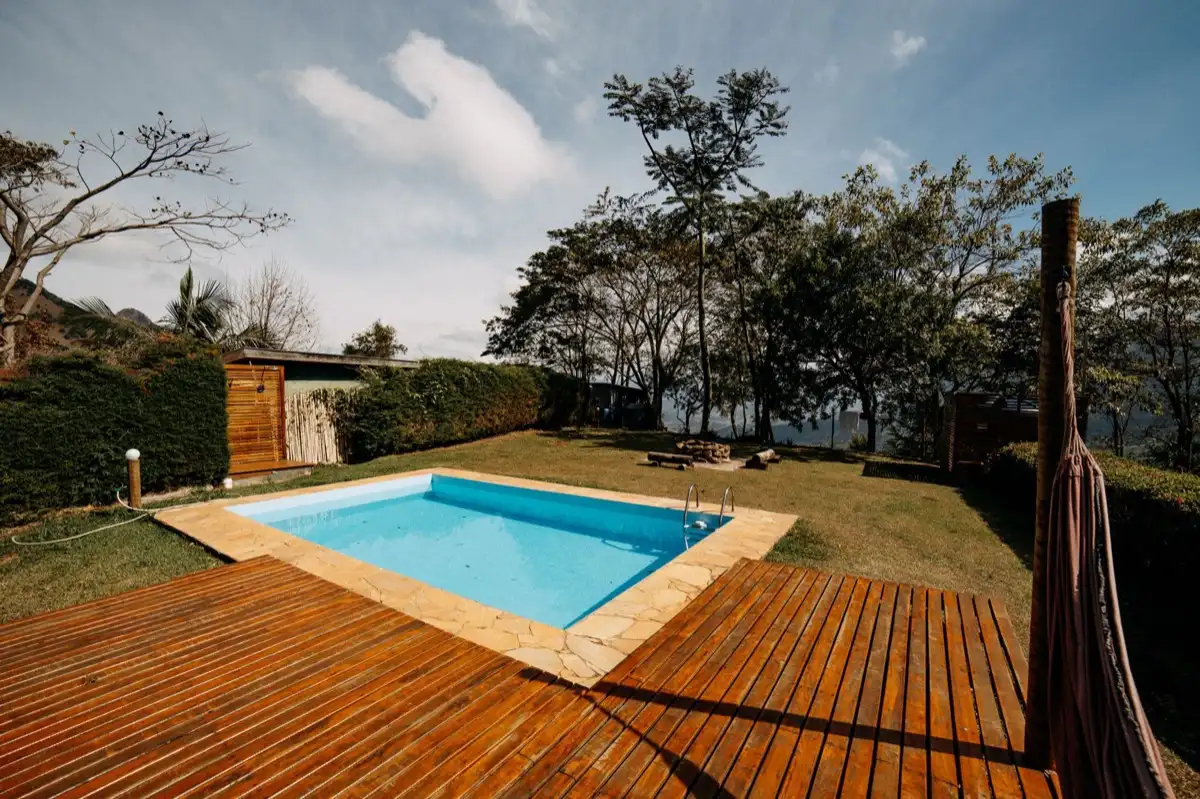
Build a patio if your yard is flat and close to your door threshold. Build a deck if the ground drops away or your back door is more than a step above grade. Slope decides this argument more often than budget does, and anyone who leads with "well, what's your budget?" is skipping the actual question.
The cost difference is real, though. A patio runs $6 to $25 per square foot depending on material. A deck runs $25 to $60. So on a flat lot, choosing a deck means paying two to four times as much for the same amount of outdoor floor. Sometimes that's the right call. Often it isn't, and we'd rather say so here than after you've paid a deposit.
The actual difference
A patio sits on the ground: concrete, pavers, stone, or gravel, on a compacted base. No framing, no footings, no fasteners.
A deck is a structure: footings, posts, beams, joists, and a walking surface, either attached to the house with a ledger or freestanding.
That's not just semantics — it drives permits, cost, lifespan, and what happens on a slope.
| Patio | Deck | |
|---|---|---|
| Installed cost/sq ft | $6–$25 | $25–$60 |
| Works on a slope? | Needs fill and retaining walls | Yes, with taller posts |
| Permit? | Often none for ground-level | Yes if attached or over 30" |
| Lifespan | 25–40 yrs | 10–15 (wood surface) to 50 (PVC) |
| Upkeep | Sealing, occasional re-leveling | Staining wood every 2–3 yrs |
| Barefoot in August | Hot, and stays hot | Hot, cools faster, shade is easier |
Slope is the tiebreaker
Here's the geometry nobody explains. Every foot of vertical drop across your patio footprint has to be dealt with somehow.
On a flat lot, a patio is straightforward: excavate, compact a base, pour or lay. Cheapest usable outdoor floor there is.
On a sloped lot, a patio means either cutting into the hill and building a retaining wall, or hauling in fill and building a wall to hold it. Retaining walls run $25 to $60 a linear foot and up, and now your cheap patio has an expensive prerequisite. A deck handles the same slope with four posts and some longer 4x4s. This is the entire reason decks exist.
And if your back door sits more than 30 inches above grade, the decision is basically made for you: you need a landing and stairs regardless, which is deck framing. Might as well get a deck out of it. Our deck stairs and landings work is mostly this exact situation.
The heat question, since this is the Rio Grande Valley
People assume a patio is cooler. It usually isn't.
Broom-finished concrete in full sun gets genuinely unpleasant, dark pavers worse, and both hold heat into the evening because of thermal mass — a slab absorbs sun all afternoon and radiates it back at you at 8 p.m. A deck with air moving underneath sheds heat faster once the sun is off it.
The bigger deal is that shade is easier to build over a deck. Posts are already going in; adding a roof or covered structure uses the same framing logic. Shading a patio means a freestanding structure with its own footings punched through your new slab. We get into board and surface temperatures in the hot-climate decking guide.
Soil movement cuts both ways
Around here, expansive clay and caliche are the local villain, and they treat the two options differently.
A patio cracks. Clay swells with moisture and shrinks when it dries, and a 400-square-foot slab riding on top of that will eventually show it. Control joints and a proper compacted base delay it. Nothing prevents it. A cracked patio is annoying and cosmetic.
A deck transfers its load to footings below the active soil zone, which is why footing depth and diameter matter so much here. What a deck can't shrug off is water at the ledger. Roughly 90 percent of deck collapses trace to the deck-to-house connection, per NADRA and the Virginia Tech research behind the IRC's ledger fastener tables. So a deck fails less often but fails worse, which is the argument for flashing and permits rather than the argument for patios.
Deck over an existing patio: the third option
If you already have a slab that's cracked, stained, or just sad-looking, you can build a low deck on top of it with a sleeper system — pressure-treated sleepers shimmed level on the concrete, decking over that. It's a great-value move and it's how a lot of ground-level floating decks get built.
Three things to check before you commit:
- Drainage. The slab has to shed water away from the house. Building a deck over a slab that puddles against the foundation traps moisture where you least want it.
- Height. A sleeper deck raises the surface 2 to 4 inches. That can change your door threshold, your step-down at the house, or push part of the deck past the 30-inch guard trigger if the yard falls away.
- Termite clearance. Wood in contact with, or within 6 inches of, damp concrete and soil needs to be ground-contact rated (UC4A). In a market where subterranean termites don't get a dormant season, that spec is not negotiable.
The opinion: on a flat lot, build the patio
If your yard is flat, your door threshold is within about 8 inches of grade, and you just want a place to put a table and a grill, build a patio and spend the difference on shade and furniture.
That's a deck builder telling you to hire a concrete crew, and the number behind it is simple: 400 square feet of patio at $10 a square foot is $4,000. The same 400 square feet of composite deck is $16,000 or more. On flat ground you are paying $12,000 for framing that gravity was handling for free.
Build the deck when the ground drops, when the door is high, when you want the space to feel like an extension of the house rather than a spot in the yard, or when you want a surface that isn't 15 degrees hotter than the air at sunset.
When neither one is the answer yet
Honest version: if you don't know how you'll use the space, build the smaller one first. The most common regret we hear isn't material choice, it's size and position — a big deck on the shady side of the house that nobody sits on, or a 10x10 landing that can't hold a table and six chairs. Measure your actual table with chairs pulled out. That's usually 10x12 minimum for six people, plus a grill zone.
Spend a summer using a $600 gravel pad and a folding table if you have to. It's the cheapest research available, and it beats a $16,000 guess. When you're ready to price the real thing, the per-square-foot cost breakdown will tell you what to expect.
Revisamos el desnivel del terreno y le explicamos las dos opciones en español.
Let someone look at the grade
Ten minutes with a level and a tape measure in your backyard settles deck versus patio more reliably than any article. McAllen Elite Deck Builders will do that for free, and if the answer is "you want a patio, not a deck," you'll hear it from us. Call (888) 321-3875.
Ready for a free quote in McAllen?
McAllen Elite Deck Builders — free estimate, clear scope, no pressure. Use the form on this page or jump to the homepage quote.
Related services in McAllen
McAllen Elite Deck Builders money pages — go straight to the service you need.
- Covered Decks & Roof Structures →
A covered deck is the only structure that makes an unshaded south- or west-facing McAllen deck usable through a July afternoon, and it is the upgrade we recommend most often. We build attached and freestanding roof structures over decks — shed, gable and hip framing with rated uplift connectors, proper wall flashing, and ceiling fans and lighting wired in during construction rather than bolted on afterward.
- Deck Stairs & Landings →
Deck stairs are the most dangerous part of any deck and the part we are called to repair most often, almost always because the risers are uneven. We build and rebuild deck stairs and landings in McAllen to the geometry that actually governs safety — risers at or under 7 3/4 inches, treads at 10 inches or more, and riser variation across a flight held under 3/8 of an inch — with graspable handrails and stringers landing on real footings.
- Floating & Ground-Level Decks →
A floating deck is freestanding, sits low, and never touches the house, which eliminates the ledger connection responsible for most catastrophic deck collapses. We build ground-level and floating decks in McAllen on gravel beds with proper drainage and ventilation clearance, in ground-contact-rated framing, at heights that keep the surface under the 30-inch mark where no guard is required.
- Composite Decking (Trex & TimberTech) →
Composite decking is the default choice for most McAllen backyards, because it will not splinter, will not need a stain every second spring, and does not feed the subterranean termites that never go dormant in Hidalgo County. We install capped composite in the Trex and TimberTech lines over a full ground-contact pressure-treated substructure, using hidden clip fasteners in grooved boards so the finished surface has no screw holes collecting water and grit.
- PVC & Cellular Decking →
Cellular PVC decking contains no wood flour whatsoever, which makes it the most rot-proof and termite-proof surface you can walk on in the Rio Grande Valley. We install PVC board in the Azek and TimberTech lines on pool surrounds, spa decks, second-story decks over living space, and any job where a client wants the lowest-maintenance product available rather than the least expensive one.
Frequently asked questions
Is a deck or patio cheaper?
A patio, by a wide margin. Poured concrete runs about $6 to $15 per square foot and pavers $10 to $25, against $25 to $60 per square foot for a deck. The gap closes on a sloped lot, because a patio on a slope needs retaining walls and fill, which is exactly the problem a deck solves with four posts.
Is a patio considered a deck?
No. A patio sits directly on the ground, usually concrete, pavers or stone, with no structural framing under it. A deck is an elevated framed structure with joists, beams and footings. That distinction drives the permit question too: decks over 30 inches or attached to the house need permits, while a ground-level patio often doesn't.
Does a deck or patio add more value to a house?
Both recoup well, and industry cost-versus-value surveys generally land deck additions in the 50 to 65 percent range of cost recouped at resale. In practice the bigger factor is fit: a deck off the back door on a sloped lot reads as usable square footage, while a patio you have to walk down three steps to reach reads as a side project.
Can you build a deck over an existing concrete patio?
Yes, on a sleeper system, and it's a common fix for cracked or ugly slabs. Two cautions: the slab has to drain away from the house, and the finished deck surface rises 2 to 4 inches, which can put your door threshold or the 30-inch guard trigger somewhere new. Call (888) 321-3875 and we'll check the slab and the threshold first.
Which lasts longer, a deck or a patio?
A patio, generally. Concrete and pavers routinely go 25 to 40 years with minimal attention, while a wood deck surface lasts 10 to 15 years and composite 25 to 50. Patios do crack and settle, and in expansive clay soil that's a real risk — but a cracked patio is a cosmetic problem where a rotted ledger is a structural one.
Local context
How this applies in McAllen, TX
Every article here is written from deck building work done in McAllen and the Rio Grande Valley, so the numbers reflect local labour, permit and material costs rather than a national average. Your own job can land either side of them depending on access, the condition of what is already there, and the materials you pick — capped composite and cellular PVC decking, ground-contact pressure-treated southern yellow pine framing, western red cedar and clear all-heart redwood.
The way to turn any of this into a real answer is to have someone look at your actual situation. The free estimate is free, itemized and written down, with no deposit and no obligation. Call (888) 321-3875 or start on the McAllen Elite Deck Builders homepage.
Areas McAllen Elite Deck Builders covers
McAllen first, then the surrounding communities of the Rio Grande Valley. Each has its own page with local detail rather than a copy of this one:
- Edinburg, TX — Hidalgo County seat, incorporated in 1919, population about 100,200, and still the fastest-growing city in the county
- Mission, TX — Hidalgo County, incorporated in 1910, population about 85,800, spread over roughly 36 square miles of former citrus groves
- Pharr, TX — Hidalgo County, incorporated in 1916, population about 79,700, across roughly 24 square miles running down to the river
- San Juan, TX — Hidalgo County, incorporated in 1917, population about 35,300, over roughly 11 square miles of former irrigated farmland
- Alamo, TX — Hidalgo County, incorporated in 1924, population about 19,500, across roughly 7.5 square miles between the expressway and the river
- Donna, TX — Hidalgo County, incorporated in 1911, population about 16,800, over roughly 8 square miles of Delta-area farmland
Or jump to the full list of McAllen services.
More from the McAllen Elite Deck Builders blog
- Best Decking for Hot Climates in McAllen Sun
Color matters more than brand. PVC reads coolest; dark composite can hit 140-170F.
- Do You Need a Permit to Build a Deck in McAllen?
Attached decks and anything over 30 inches high need a permit. Freestanding decks under 200 sq ft usually don't.
- How Long Does a Deck Last in McAllen Heat?
Wood decking lasts 10-15 years, composite 25-50, ipe 40+. The frame usually outlives the boards.
The McAllen Elite Deck Builders Team
deck building specialists serving McAllen, TX
Written by the McAllen Elite Deck Builders team — insured deck building pros with 20+ years serving McAllen, TX and the surrounding area.