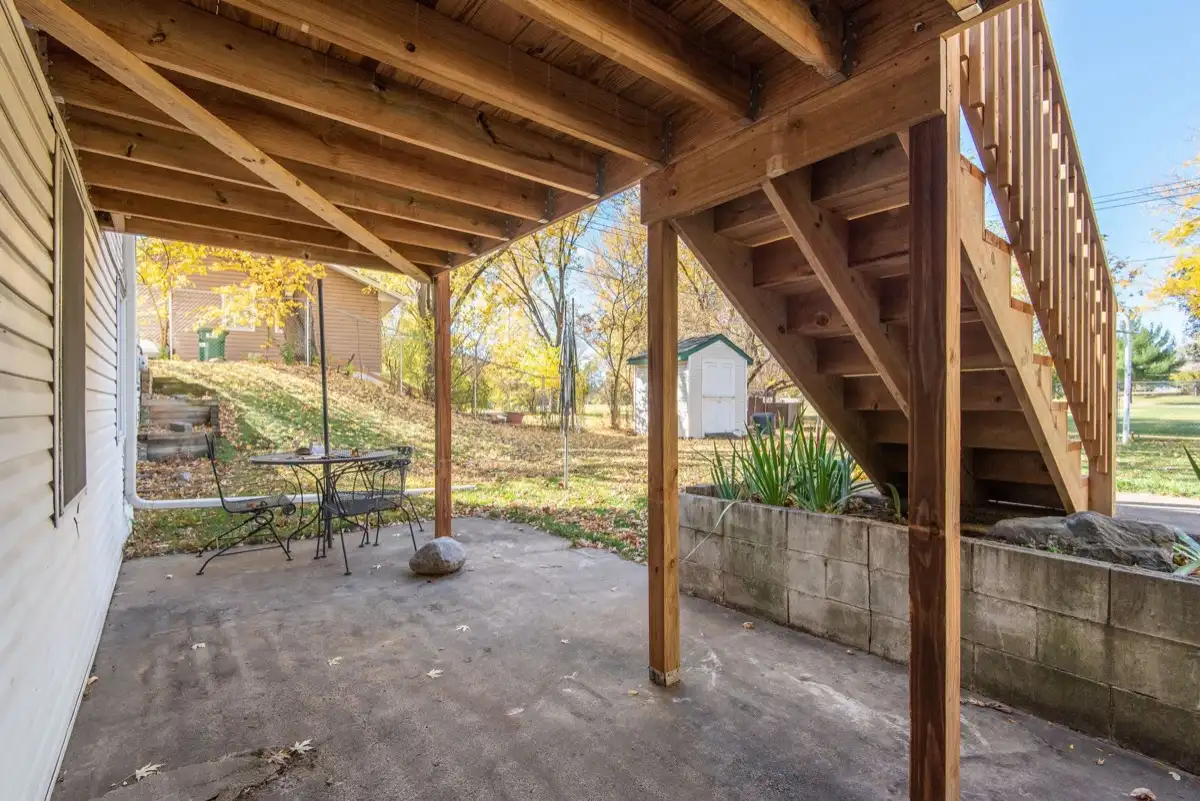
The test that settles this costs nothing: take a flashlight and a flathead screwdriver under the deck and push the tip into the joist tops near the house, the ledger board, and the posts where they meet the ground. Sound wood stops the screwdriver. Rot lets it sink in like sponge cake. Everything else on this page is detail.
Here's the money version of the same idea. If the frame is bad, you're replacing the deck: $25 to $60 per square foot. If only the surface and railing are bad, you're resurfacing: roughly $12 to $22 per square foot for the same finished result. Plenty of decks that look terrible are structurally fine, and plenty of decks that look presentable are one crowded barbecue away from a very bad afternoon.
The eight signs below run in order of severity. The first three are structural. The last five usually aren't.
1. Anything wrong at the ledger
The ledger is the board bolting your deck to the house, and it is the most important piece of lumber in the assembly. NADRA and the Virginia Tech research that produced the IRC's ledger fastener tables attribute roughly 90 percent of deck collapses to this one connection.
What to look for: dark staining or soft wood where the deck meets the wall, rust streaks, siding that's buckled or stained above the deck line, or — the big one — nails instead of bolts or structural screws. Nailed ledgers were standard practice on American decks built before roughly 2004. They're not acceptable under current code, and nails resist pull-out poorly and loosen with decades of wood movement.
Also look for the absence of flashing: a metal cap over the ledger tucked behind the house's water barrier. If you see caulk instead, water has been running into the sheathing behind that board for years.
Verdict: replace, or at minimum have the connection rebuilt before anybody else stands on it. This is not a wait-and-see item.
2. Soft or spongy joists, beams or posts
Do the screwdriver test in three places: joist tops (they collect water in every screw hole), the bottom of the posts at grade, and the beam ends.
Posts buried directly in concrete are a common find on older decks and a reliable source of rot — the concrete cups water around the post like a flowerpot. Modern practice sets posts on standoff bases that keep wood above the wet.
One or two joists can be sistered or replaced. Widespread softness means replacement. If more than a handful of framing members are going, the labor to fix them piecemeal starts approaching the cost of doing it right.
3. The deck moves when you walk on it
Stand near an outer corner and shift your weight side to side. A deck should feel like a floor. If it sways laterally, rocks, or you can see the guard posts flexing, something isn't connected the way it should be — missing lateral load connectors, loose post-to-beam hardware, or a beam that isn't properly seated.
Sway is also how a deck tells you it's been dealing with wind uplift. Along the Gulf Coast, hurricane ties and uplift connectors at the joist-to-beam and beam-to-post connections aren't decoration; a deck is a large flat surface with air underneath, which is more or less the definition of a wing.
Verdict: structural. Get it looked at before the next party, not after.
4. Corroded, missing or wrong hardware
Get the flashlight on the joist hangers. Two failures show up constantly:
- Empty holes. Joist hangers are rated on the assumption that every hole has an approved joist-hanger nail in it. Deck screws in a hanger are not equivalent and never were.
- Rust. Modern preservative treatments (ACQ, CA) are harder on metal than the old CCA lumber, so plain galvanized hardware in humid air corrodes faster than people expect. Rust streaks running down your decking are the visible symptom.
Hardware alone can sometimes be corrected. Hardware corrosion plus soft wood is a rebuild.
5. Widespread cupping, checking and splinters
Now we're into surface problems, which are the good news category.
A pressure-treated or cedar surface lasts 10 to 15 years here before it starts cupping, checking and throwing splinters. That's normal, not a failure. Our deck lifespan guide breaks the numbers down by material.
Rough rule: if more than about 15 percent of the boards are cupped, cracked or spongy, replace the surface rather than chasing individual boards. Below that, swap boards.
Verdict: resurface. Keep the frame.
6. Fasteners popping, and holes that won't hold
Screws that back out every season, nails lifting, screw holes that spin freely — the wood around the fastener has given up even if the board looks fine. On a deck built with face screws, this is often the first honest sign the surface is done.
While the boards are off is also the moment to add butyl joist tape across the joist tops, at roughly $0.35 to $0.70 per linear foot. It's the highest-return upgrade on a deck and it's nearly free at resurface time because the frame is already exposed.
7. The guard fails the push test
Lean into the railing with your hip — firmly. IRC Table R301.5 loads a guard with 200 pounds from any direction, which means it should feel like a wall. If it flexes, wobbles, or you can rock a post, that guard is decorative.
Then check two dimensions: residential guards must be at least 36 inches tall (IRC R312.1.2), and no opening may pass a 4-inch sphere (R312.1.3). Older decks frequently have 30-inch guards with 5-inch picket gaps, which was fine when built and isn't now. Our railing height code guide covers the 36-versus-42-inch confusion.
Verdict: replace the guard, not necessarily the deck. New deck railing on a sound frame is a one to two day job.
8. Stairs that are quietly the worst part
Stairs cause more injuries than deck surfaces do, and they're where DIY work shows.
- Riser heights must be uniform within 3/8 inch across the whole flight. Uneven risers are a trip hazard your brain can't compensate for.
- Handrails are required and must be graspable, mounted 34 to 38 inches above the tread nosing. A flat board capping the guard has never qualified.
- Stringer rot at the bottom, where the stringer meets grade or a slab, is nearly universal on older decks.
Verdict: stairs and landings can be rebuilt on their own. Do it before someone finds the problem the hard way.
The opinion: a pre-2004 deck deserves a look regardless of how it presents
If your deck was built before roughly 2004, have the ledger connection evaluated even if the deck looks completely fine. The nailed-ledger era ended because researchers spent years documenting why it collapses, and those decks are now 22-plus years old with two decades of wood movement behind them.
That's a 20-minute inspection. It's also the only failure mode on this list that goes from "no visible symptoms" to "the entire deck is on the ground" without a warning stage. The other seven signs give you notice. This one doesn't always.
When you should absolutely not hire anybody
Straight answer: replacing two or three bad boards is a DIY job. Pull them, cut replacements to length, fasten into sound joists, done in an afternoon for the price of the lumber. Tightening loose railing hardware and re-driving popped screws is the same category. Nobody should charge you a service call for that, and if the frame is sound you may have five more years of doing exactly this.
Call a builder when the screwdriver goes into framing, when the deck moves, when there's any question at the ledger, or when more than 15 percent of the surface is failing. Those are the four things that stop being maintenance and start being structural. If it's the surface, resurfacing is half the price of new construction — and our cost-per-square-foot breakdown shows exactly where the two paths diverge.
Hacemos la inspección y le explicamos los hallazgos en español, sin compromiso.
Get the honest verdict first
McAllen Elite Deck Builders will crawl under it with a flashlight and tell you which of the two conversations you're having — new boards, or a new deck. We talk people out of the expensive version regularly, because a good frame is worth keeping. Call (888) 321-3875 for a free assessment.
Ready for a free quote in McAllen?
McAllen Elite Deck Builders — free estimate, clear scope, no pressure. Use the form on this page or jump to the homepage quote.
Related services in McAllen
McAllen Elite Deck Builders money pages — go straight to the service you need.
- Deck Railings: Cable, Glass, Aluminum & Wood →
Deck railings are the most safety-critical part of a deck and the most common thing built wrong, because a guard has to resist a 200 pound concentrated load in any direction and most site-built wood railings never could. We install stainless cable, tempered glass, powder-coated aluminum and wood railing systems in McAllen, with posts and connections engineered for the actual loads and openings that satisfy the 4-inch sphere rule.
- Deck Stairs & Landings →
Deck stairs are the most dangerous part of any deck and the part we are called to repair most often, almost always because the risers are uneven. We build and rebuild deck stairs and landings in McAllen to the geometry that actually governs safety — risers at or under 7 3/4 inches, treads at 10 inches or more, and riser variation across a flight held under 3/8 of an inch — with graspable handrails and stringers landing on real footings.
- Deck Resurfacing & Board Replacement →
Deck resurfacing keeps your sound substructure and replaces only what you walk on and hold onto, and it usually costs well under half of a full rebuild. We inspect the frame first, then re-deck McAllen decks with new composite, PVC or wood surfaces and new railing, retrofitting joist tape over every joist top and sistering or replacing anything that will not outlast the new surface.
- Composite Decking (Trex & TimberTech) →
Composite decking is the default choice for most McAllen backyards, because it will not splinter, will not need a stain every second spring, and does not feed the subterranean termites that never go dormant in Hidalgo County. We install capped composite in the Trex and TimberTech lines over a full ground-contact pressure-treated substructure, using hidden clip fasteners in grooved boards so the finished surface has no screw holes collecting water and grit.
- PVC & Cellular Decking →
Cellular PVC decking contains no wood flour whatsoever, which makes it the most rot-proof and termite-proof surface you can walk on in the Rio Grande Valley. We install PVC board in the Azek and TimberTech lines on pool surrounds, spa decks, second-story decks over living space, and any job where a client wants the lowest-maintenance product available rather than the least expensive one.
Frequently asked questions
How do you tell if a deck needs replacing?
Push a screwdriver into the joist tops near the house, the ledger board, and the posts at grade. If it sinks in like sponge cake, that's rot and you're looking at replacement. If the frame is solid and only the surface boards and railing are worn, you need a resurface instead, which costs roughly half as much.
What accounts for 90% of deck collapses?
The ledger connection — where the deck attaches to the house. NADRA and Virginia Tech research put roughly 90 percent of deck collapses on that joint, usually because the ledger was nailed rather than bolted and was never flashed. The IRC now prescribes the fastener schedule in R507.9 and requires flashing there.
Is it cheaper to repair or replace a deck?
Repair, until the frame is involved. Swapping bad boards and re-fastening runs a few hundred dollars. Resurfacing a sound frame with new decking and railing runs about $12 to $22 per square foot. Full replacement is $25 to $60. The dividing line is whether the ledger, joists and posts are sound, not how bad the top looks.
What's the average price to replace a deck?
For a 300 to 400 square foot deck, roughly $8,000 to $24,000 depending on material, height and railing. Pressure-treated pine sits at the bottom, mid-grade composite in the middle, tropical hardwood at the top. Demolition and haul-away typically adds $500 to $1,500 on top.
Can you replace just the deck boards?
Yes, and it's the most common fix on a 12 to 15 year old deck. Measure your joist spacing first, though. Composite boards carry a published maximum span that plenty of pre-2000 frames exceed, and a diagonal layout tightens it further. If your frame is too wide for the board you want, wood decking or a new frame are the honest options. Call (888) 321-3875 and we'll measure it.
Local context
How this applies in McAllen, TX
Every article here is written from deck building work done in McAllen and the Rio Grande Valley, so the numbers reflect local labour, permit and material costs rather than a national average. Your own job can land either side of them depending on access, the condition of what is already there, and the materials you pick — capped composite and cellular PVC decking, ground-contact pressure-treated southern yellow pine framing, western red cedar and clear all-heart redwood.
The way to turn any of this into a real answer is to have someone look at your actual situation. The free estimate is free, itemized and written down, with no deposit and no obligation. Call (888) 321-3875 or start on the McAllen Elite Deck Builders homepage.
Areas McAllen Elite Deck Builders covers
McAllen first, then the surrounding communities of the Rio Grande Valley. Each has its own page with local detail rather than a copy of this one:
- Edinburg, TX — Hidalgo County seat, incorporated in 1919, population about 100,200, and still the fastest-growing city in the county
- Mission, TX — Hidalgo County, incorporated in 1910, population about 85,800, spread over roughly 36 square miles of former citrus groves
- Pharr, TX — Hidalgo County, incorporated in 1916, population about 79,700, across roughly 24 square miles running down to the river
- San Juan, TX — Hidalgo County, incorporated in 1917, population about 35,300, over roughly 11 square miles of former irrigated farmland
- Alamo, TX — Hidalgo County, incorporated in 1924, population about 19,500, across roughly 7.5 square miles between the expressway and the river
- Donna, TX — Hidalgo County, incorporated in 1911, population about 16,800, over roughly 8 square miles of Delta-area farmland
Or jump to the full list of McAllen services.
More from the McAllen Elite Deck Builders blog
- How to Clean Composite Decking on a McAllen Deck
Soap, water and a soft brush do 95% of it. Bleach lightens the cap; a close washer tip scars it.
- Deck vs Patio in McAllen: Which Should You Build?
Patios cost $6-$20 a square foot, decks $25-$60. Slope decides more than budget does.
- Best Decking for Hot Climates in McAllen Sun
Color matters more than brand. PVC reads coolest; dark composite can hit 140-170F.
The McAllen Elite Deck Builders Team
deck building specialists serving McAllen, TX
Written by the McAllen Elite Deck Builders team — insured deck building pros with 20+ years serving McAllen, TX and the surrounding area.