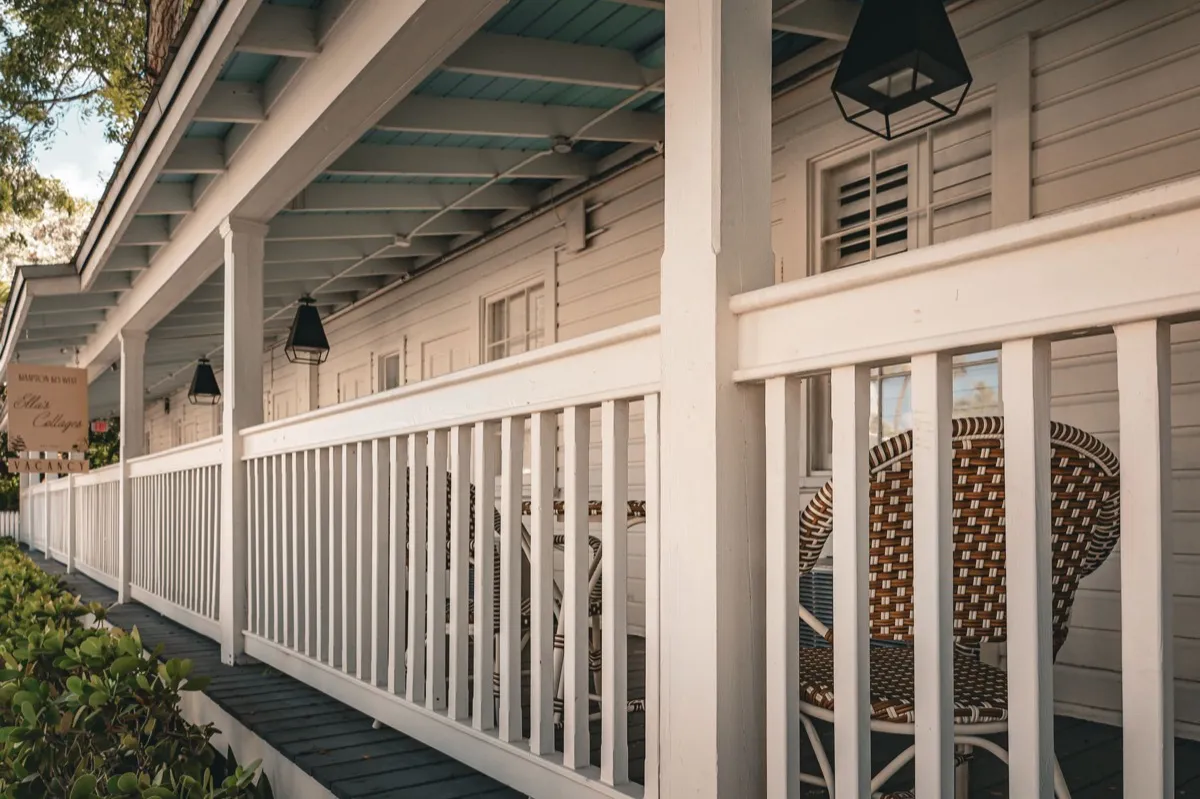
Thirty-six inches, if this is a house. That's the minimum residential guard height in IRC R312.1.2, measured from the deck walking surface to the top of the guard. Forty-two inches is the commercial number out of the IBC, and a small number of jurisdictions apply 42 to residential decks too — which is the entire reason this question is confusing enough to need an article.
So the useful version of the answer is: build to 36 unless your city says otherwise, and find out which it is before you order railing, because guard components come cut to height and returning 60 linear feet of the wrong one is a conversation nobody enjoys.
The four numbers that matter
| Requirement | Number | Code |
|---|---|---|
| Guard required above | 30 inches above grade | IRC R312.1.1 |
| Residential guard height | 36 inches minimum | IRC R312.1.2 |
| Commercial guard height | 42 inches minimum | IBC |
| Opening size | No 4-inch sphere passes | IRC R312.1.3 |
| Stair triangle opening | No 6-inch sphere passes | IRC R312.1.3 |
| Stair handrail height | 34–38 inches above nosing | IRC R311.7.8.1 |
| Guard load resistance | 200 lb concentrated, any direction | IRC Table R301.5 |
Memorize 30, 36, 4, and 200 and you know more about deck guards than most of the people bidding on your job.
The 30-inch trigger, and why it's worth designing around
A guard is required on any open-sided walking surface more than 30 inches above the floor or grade below, measured within 36 inches horizontally of the edge. That last clause matters on a sloped lot: if the ground falls away, you measure to the actual grade below, not to the highest point next to the deck.
At 30 inches or under, you can leave the edges open. This is genuinely one of the biggest cost levers on a deck, because guards run $70 to $200 per linear foot installed. On a 20x20 deck with three open sides — 60 linear feet — that's $4,200 to $12,000 of railing.
Which is why a ground-level or floating deck at 8 inches off the slab is so much cheaper than the same deck at 36 inches. Not because of the framing. Because of the guard you didn't have to build. The full breakdown is in our per-square-foot cost guide.
The 4-inch sphere rule catches more people than height does
No opening anywhere in the guard may pass a 4-inch-diameter sphere. In practice this means baluster gaps land at 3-1/2 to 3-7/8 inches on center-to-face spacing, and — this is the part that gets missed — the rule applies under the bottom rail too. A guard with a beautifully spaced picket array and a 5-inch gap between the bottom rail and the deck surface fails.
Where it really bites is cable railing, which everyone wants and which is the most commonly failed installation we see. Cable is flexible. The sphere test is applied to the guard as installed and under load, so cables that measure 3 inches apart at rest can spread past 4 inches when a child leans on them. Compliant cable systems therefore need:
- Tight cable spacing, typically around 3 to 3-1/8 inches.
- Intermediate supports every 3 to 4 feet to limit deflection.
- Serious end-post framing, because a run of cables at proper tension pulls with thousands of pounds of cumulative force. Corner and end posts have to be engineered for that, not just bolted on.
Cable railing is beautiful and it is not a beginner project. Neither is glass, which needs tempered or laminated panels and clamps rated for the load. Both are worth doing — see our deck railing options — just not on a Saturday.
The 200-pound rule is really about the post
Here's the technical detail that separates a real railing from a decorative one: the guard has to resist a 200-pound concentrated load applied in any direction at the top rail. All of that force ends up as bending stress at the base of the guard post.
The traditional detail — notching a 4x4 post around the rim joist and running two bolts through it — has been tested and frequently fails, because the notch removes most of the post's cross-section right at the point of maximum bending stress. Better details:
- Unnotched posts bolted to the inside face of the rim with a hold-down tension tie (the Simpson DTT2Z is the common one) tying the post base to the joist.
- Blocking between joists at every post so the load is spread across the frame instead of trying to peel one rim joist off.
- Through-bolts with washers, not lag screws into end grain, and not deck screws under any circumstances.
The homeowner's version of this test takes two seconds: lean into the railing with your hip. Not gently. A compliant guard should feel like a wall. If it flexes or you can rock the post, it will not hold a falling adult, whatever height it is.
Stairs have their own set of rules
People merge stairs and guards into one item and they're separate.
- Guards are required on stairs more than 30 inches above grade, and on stairs the triangular opening formed by the tread, riser and bottom rail is allowed a 6-inch sphere rather than 4.
- Handrails are required and are a different component: 34 to 38 inches above the tread nosing, continuous, graspable. Graspable means a profile your hand can actually close around. A 2x6 laid flat on top of the guard is a shelf, not a handrail, and it fails inspection every time.
- Riser height must be uniform within 3/8 inch across the flight.
If your stairs and landings predate about 2000, there's a decent chance the handrail is either missing or non-graspable. It's a cheap fix and it's the single most-used safety component on the whole deck.
The opinion: build 36, not 42, unless you're told to
If your code allows 36 inches, build 36 inches. The extra 6 inches costs more material, and more importantly it sits directly in your sight line when you're seated. The reason people install 42-inch guards on homes is usually that a salesperson said "taller is safer," which is true in the same sense that a wall is safer than a window.
The genuine safety variable isn't the 6 inches — it's whether the guard resists 200 pounds and whether the openings pass the sphere test. A rock-solid 36-inch guard with proper post hold-downs is meaningfully safer than a wobbly 42-inch one, and we've replaced plenty of the latter.
Commercial and multifamily work is a different question entirely: commercial decks and boardwalks go to 42 inches and get inspected against the IBC.
When you don't need a contractor
Honest limits. Swapping rotted wood pickets on an existing, solid guard frame is a DIY job. Buy the pickets, use a 3-1/2 inch spacer block so you never have to measure, drive stainless screws, done in an afternoon. Same for adding a proper graspable handrail to a stair run — that's a $60 part and an hour.
What isn't DIY: anything involving post attachment. If the posts are loose, notched, or bolted with lags into end grain, that's a structural detail with a 200-pound test attached to it, and getting it wrong looks completely fine right up until it doesn't. Cable and glass systems belong in the same category, for the load reasons above.
And if the whole guard is short, gappy, and 25 years old, it's usually cheaper to replace the run than to modify it. Whether the frame holding it up is worth keeping is a separate question — the eight-sign deck inspection settles that one.
Le explicamos los requisitos del código y las opciones de barandal en español.
Get the local number before you buy railing
The 36-versus-42 question has exactly one authoritative answer and it's whichever the McAllen building department is enforcing. McAllen Elite Deck Builders confirms it as part of the permit, prices the guard by the linear foot so you can compare bids honestly, and details the posts so they pass the hip test. Call (888) 321-3875.
Ready for a free quote in McAllen?
McAllen Elite Deck Builders — free estimate, clear scope, no pressure. Use the form on this page or jump to the homepage quote.
Related services in McAllen
McAllen Elite Deck Builders money pages — go straight to the service you need.
- Deck Railings: Cable, Glass, Aluminum & Wood →
Deck railings are the most safety-critical part of a deck and the most common thing built wrong, because a guard has to resist a 200 pound concentrated load in any direction and most site-built wood railings never could. We install stainless cable, tempered glass, powder-coated aluminum and wood railing systems in McAllen, with posts and connections engineered for the actual loads and openings that satisfy the 4-inch sphere rule.
- Deck Stairs & Landings →
Deck stairs are the most dangerous part of any deck and the part we are called to repair most often, almost always because the risers are uneven. We build and rebuild deck stairs and landings in McAllen to the geometry that actually governs safety — risers at or under 7 3/4 inches, treads at 10 inches or more, and riser variation across a flight held under 3/8 of an inch — with graspable handrails and stringers landing on real footings.
- Commercial Decks & Boardwalks →
Commercial deck work is built to a different set of numbers than residential, starting with 42-inch guards carrying a 50 pound per linear foot load on top of the 200 pound concentrated load. We build restaurant and bar patios, multifamily and HOA walkways and stair systems, hotel pool decks, and public boardwalks and observation platforms across McAllen and Hidalgo County, with ADA-compliant handrails and landings and helical pier foundations over soft ground.
- Composite Decking (Trex & TimberTech) →
Composite decking is the default choice for most McAllen backyards, because it will not splinter, will not need a stain every second spring, and does not feed the subterranean termites that never go dormant in Hidalgo County. We install capped composite in the Trex and TimberTech lines over a full ground-contact pressure-treated substructure, using hidden clip fasteners in grooved boards so the finished surface has no screw holes collecting water and grit.
- PVC & Cellular Decking →
Cellular PVC decking contains no wood flour whatsoever, which makes it the most rot-proof and termite-proof surface you can walk on in the Rio Grande Valley. We install PVC board in the Azek and TimberTech lines on pool surrounds, spa decks, second-story decks over living space, and any job where a client wants the lowest-maintenance product available rather than the least expensive one.
Frequently asked questions
Is a deck railing 36 or 42 inches?
Thirty-six inches minimum for a residential deck under IRC R312.1.2, measured from the deck surface to the top of the guard. Forty-two inches is the commercial figure from the IBC, and a handful of jurisdictions apply 42 inches to homes too. Confirm with the McAllen building department before you buy railing, because the parts are cut to height.
How high can a deck be without a railing?
Thirty inches. IRC R312.1.1 requires a guard on any open-sided walking surface more than 30 inches above the floor or grade below, measured within 36 inches horizontally of the edge. At 30 inches or less you can legally leave it open, which is exactly why ground-level decks cost so much less to build.
What is the 4-inch rule for deck railings?
IRC R312.1.3 says no opening in a guard may allow a 4-inch-diameter sphere to pass through. It applies everywhere on the guard, including under the bottom rail and between the guard and the deck surface. On stair guards, the triangular opening formed by the tread, riser and bottom rail gets a 6-inch sphere instead.
How much load does a deck guard have to hold?
A 200-pound concentrated load applied in any direction at the top. That number is why post attachment matters more than picket style — a notched 4x4 bolted through a rim joist often fails it, while the same post with a hold-down tension tie passes. Lean into your railing with your hip; a compliant guard should not move.
What height is a stair handrail on a deck?
Between 34 and 38 inches above the tread nosing, and it has to be graspable — a round or shaped profile your hand can close around, not a 2x6 laid flat on top of the guard. Stairs also need a guard where they're more than 30 inches up, and the two are separate requirements that people constantly merge into one.
Local context
How this applies in McAllen, TX
Every article here is written from deck building work done in McAllen and the Rio Grande Valley, so the numbers reflect local labour, permit and material costs rather than a national average. Your own job can land either side of them depending on access, the condition of what is already there, and the materials you pick — capped composite and cellular PVC decking, ground-contact pressure-treated southern yellow pine framing, western red cedar and clear all-heart redwood.
The way to turn any of this into a real answer is to have someone look at your actual situation. The free estimate is free, itemized and written down, with no deposit and no obligation. Call (888) 321-3875 or start on the McAllen Elite Deck Builders homepage.
Areas McAllen Elite Deck Builders covers
McAllen first, then the surrounding communities of the Rio Grande Valley. Each has its own page with local detail rather than a copy of this one:
- Edinburg, TX — Hidalgo County seat, incorporated in 1919, population about 100,200, and still the fastest-growing city in the county
- Mission, TX — Hidalgo County, incorporated in 1910, population about 85,800, spread over roughly 36 square miles of former citrus groves
- Pharr, TX — Hidalgo County, incorporated in 1916, population about 79,700, across roughly 24 square miles running down to the river
- San Juan, TX — Hidalgo County, incorporated in 1917, population about 35,300, over roughly 11 square miles of former irrigated farmland
- Alamo, TX — Hidalgo County, incorporated in 1924, population about 19,500, across roughly 7.5 square miles between the expressway and the river
- Donna, TX — Hidalgo County, incorporated in 1911, population about 16,800, over roughly 8 square miles of Delta-area farmland
Or jump to the full list of McAllen services.
More from the McAllen Elite Deck Builders blog
- 8 Signs Your McAllen Deck Needs Replacing
A screwdriver and a flashlight settle it. The 8 checks that separate a resurface from a full rebuild on a McAllen, TX deck, in order of severity.
- How to Clean Composite Decking on a McAllen Deck
Soap, water and a soft brush do 95% of it. Bleach lightens the cap; a close washer tip scars it.
- Deck vs Patio in McAllen: Which Should You Build?
Patios cost $6-$20 a square foot, decks $25-$60. Slope decides more than budget does.
The McAllen Elite Deck Builders Team
deck building specialists serving McAllen, TX
Written by the McAllen Elite Deck Builders team — insured deck building pros with 20+ years serving McAllen, TX and the surrounding area.