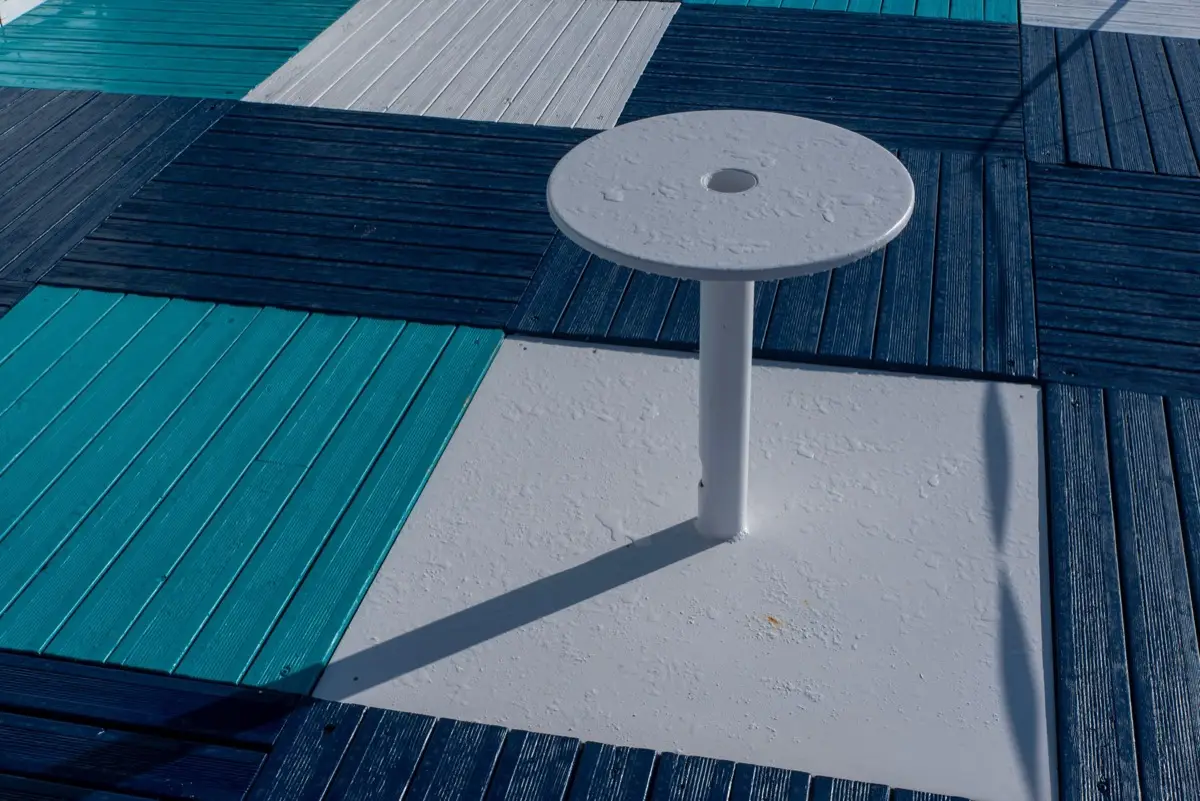
The coolest decking in full sun is light-colored PVC, followed closely by light-colored wood. The hottest is dark capped composite, which has been measured at 140 to 170°F on a hot afternoon. And the single most important thing on this page is that color matters more than brand — a light board from a mid-range line will beat a dark board from a premium one, every time, by a wider margin than any marketing claim.
Which is a slightly awkward thing for a deck builder to lead with, since the dark espresso boards are the ones everybody points at in the showroom. They photograph beautifully. They also turn into a griddle by 1 p.m., and then you own a very handsome deck you look at through a window.
What the temperature numbers actually say
Published testing and manufacturer data line up on a few points:
- Composite runs 10 to 35°F hotter than untreated wood in direct sun.
- Dark capped composite can reach 140 to 170°F on a 90-plus degree day.
- Color moves it more than brand does. A Michigan deck builder, Custom Deck Creations, laid five Trex colors out at 80°F ambient and read 93°F on a light brown, 98°F on a medium brown and 101°F on a dark brown — but the boards were lying on cool grass, which the tester flags himself, and a second dark brown in the same batch came in at 96°F, below the medium. Treat that run as the direction of the color effect, not its size.
- The same tester's full-sun run is the one to plan around: Trex left out all day at 86°F ambient read 135 to 137°F in the light browns and 147 to 148°F in the darks, with stained ipe at 136 to 137°F and stained pine between 119 and 133°F. That is roughly a 10 to 13 degree color penalty at temperatures you would actually be standing on.
- Heat-mitigating composite lines claim up to 35°F cooler than that brand's own standard boards.
- Advanced PVC lines claim up to 30°F cooler than competitive composite products.
For scale: bare skin starts registering pain somewhere around 120 to 125°F. So the question in McAllen isn't whether the deck gets warm. It's whether it crosses the "hop, hop, ow" line during the hours you'd actually want to be out there.
The ranking, coolest to hottest
| Rank | Material | Why |
|---|---|---|
| 1 | Light PVC / cellular | No wood flour in the core, lightest colors available, sheds heat fast |
| 2 | Light-sealed pine or cedar | Low density, light color, dissipates quickly |
| 3 | Heat-mitigating composite lines | Real improvement over standard composite, still warmer than wood |
| 4 | Light standard composite | Livable in shade, warm in full sun |
| 5 | Ipe and dense hardwood | Beautiful, bulletproof, and dense — density means heat storage |
| 6 | Dark composite, any brand | The one people regret |
Ipe deserves a note. It is the most durable deck surface money buys and it does get hot, because 69-plus pounds per cubic foot of dense hardwood stores thermal energy the way a cast iron pan does. Nobody should talk you out of ipe — just don't buy it expecting a cool surface, and put shade over the seating area.
Heat is not the only thing the sun does
Surface temperature is the complaint people notice. Three others cost more money.
UV degradation. Ultraviolet light breaks down lignin in wood and fades pigment in everything. A south or west-facing deck with no shade will look about five years older than an identical shaded deck of the same age. Wood in this climate wants a stain with real UV blockers, and it wants it every 2 to 3 years, not "when it looks bad."
Thermal movement. Composite and PVC expand and contract with temperature considerably more than wood. In a market that swings from 40°F in January to 105°F in August, end gaps have to be set from the manufacturer's chart at the actual install temperature. Get it wrong and boards either buckle in summer or open up like a picket fence in winter. This is where cheap installs reveal themselves about 14 months later.
Fastener expansion. Hidden fastener clip systems accommodate that movement by design, which is a real functional argument for them here, not just a cosmetic one.
The fix that beats every board choice
Shade. It isn't close.
A board sitting in shade is 30 to 50 degrees cooler than the same board in full sun, which is a bigger swing than the entire range between the coolest and hottest products on the market. A pergola or shade structure over the seating third of the deck costs a fraction of upgrading every board on it, and it makes the deck usable at 4 p.m. instead of 8 p.m.
Two more cheap moves worth knowing:
- Keep air moving under the deck. A ventilated substructure sheds heat; a deck skirted solid to the ground traps it and holds moisture against your framing at the same time. Lattice or slat skirting, not sealed panels.
- Orient the deck if you still can. East-facing gets morning sun and afternoon shade. It's free at the design stage and impossible later.
For pool decks this all matters double, because that's the one deck people are guaranteed to walk on barefoot, wet, and at the hottest hour of the day. Light boards there aren't a preference, they're the spec.
The opinion: pick the color first, the brand second
Walk into the showroom, pull every board lighter than a paper bag, and choose from that pile. Then compare brands, warranties and price within it. Doing it the other way around — brand first, then "which color do you like?" — is how people end up with a 160-degree deck and a 50-year warranty on it.
The number backing that up is the 8-degree spread measured across three colors of a single product line, versus the up-to-30-degree claim between product categories. Color is not a small lever, and it's the only one that costs nothing.
When you shouldn't rebuild anything
Here's the honest version of this whole article: if your deck is structurally fine and the only problem is that it's hot, don't replace the boards. Replacing 400 square feet of decking to chase a cooler surface costs $12 to $22 a square foot. A pergola, a shade sail, or a decent market umbrella over the seating area costs a small fraction of that and drops the surface temperature further than any board swap would.
Change the boards when they're failing, when you're already resurfacing, or when you're building new. Then choose light. If you're at that decision point anyway, our composite versus wood comparison and deck lifespan guide cover the rest of the tradeoff.
Le mostramos las muestras de color y le explicamos las diferencias de temperatura en español.
Bring the samples out to the driveway
The best test costs nothing and takes an hour: put your two favorite board samples on the driveway at 2 p.m., come back, and touch them. Manufacturers publish relative claims. Your own hand on hot concrete in the Rio Grande Valley publishes the truth.
McAllen Elite Deck Builders will drop samples off and talk through color, shade and gapping before anybody signs anything. Call (888) 321-3875.
Ready for a free quote in McAllen?
McAllen Elite Deck Builders — free estimate, clear scope, no pressure. Use the form on this page or jump to the homepage quote.
Related services in McAllen
McAllen Elite Deck Builders money pages — go straight to the service you need.
- PVC & Cellular Decking →
Cellular PVC decking contains no wood flour whatsoever, which makes it the most rot-proof and termite-proof surface you can walk on in the Rio Grande Valley. We install PVC board in the Azek and TimberTech lines on pool surrounds, spa decks, second-story decks over living space, and any job where a client wants the lowest-maintenance product available rather than the least expensive one.
- Pool Decks & Pool Surrounds →
Pool decks take more abuse than any other deck we build, and around water we specify cellular PVC or capped composite rather than wood almost every time. We build pool surrounds, above-ground pool decks and spa platforms in McAllen with stainless hardware throughout, slip-resistant surfaces, engineered spa framing, and barrier and gate details that satisfy the pool enclosure requirements.
- Pergolas & Shade Structures →
A pergola is the least expensive way to make a McAllen deck usable in the afternoon, and how much shade it actually delivers depends entirely on rafter spacing and orientation rather than on how good it looks in the brochure. We build cedar, redwood and powder-coated aluminum pergolas, including adjustable louvered systems, with uplift anchoring at every post and posts set on piers with standoff bases.
- Composite Decking (Trex & TimberTech) →
Composite decking is the default choice for most McAllen backyards, because it will not splinter, will not need a stain every second spring, and does not feed the subterranean termites that never go dormant in Hidalgo County. We install capped composite in the Trex and TimberTech lines over a full ground-contact pressure-treated substructure, using hidden clip fasteners in grooved boards so the finished surface has no screw holes collecting water and grit.
- Cedar Decks →
Cedar decks stay cooler underfoot than any synthetic board, which is why western red cedar is still the right answer for a McAllen deck that gets full afternoon sun and no roof over it. We build in clear and select-grade cedar with tight vertical grain, fastened with stainless steel screws, on a ground-contact pressure-treated substructure that never depends on the cedar for its structural life.
Frequently asked questions
What decking material stays the coolest?
Light-colored PVC and light-colored wood are the two coolest options in full sun. Dark capped composite is the hottest, measured at 140 to 170 degrees F on hot afternoons in published tests. Color is a bigger factor than material: a light board in any material beats a dark board in a premium one.
Does composite decking get hot?
Yes. Composite runs roughly 10 to 35 degrees F hotter than untreated wood in direct sun, and the wood-plastic core holds that heat longer.
Builder testing by Custom Deck Creations put five Trex colors side by side at 80 degrees ambient and got 93 in a light brown up to 101 in a dark one, though those boards sat on cool grass and one dark color read lower than the medium.
Their full-sun run at 86 degrees is the honest number: 135 in the light browns, 147 to 148 in the darks.
Is there a composite decking that doesn't get hot?
Nothing in full McAllen sun is cool, but heat-mitigating lines now claim up to 35 degrees F cooler than the same brand's standard boards, and advanced PVC lines claim up to 30 degrees cooler than competitive composites. Treat those as relative improvements, not air conditioning. Shade does more than any board.
Is wood cooler than composite in the sun?
Usually yes, by 10 to 35 degrees. Wood is less dense, lighter in color when sealed with a clear or light stain, and sheds heat faster. The trade is upkeep. A wood surface here wants a clean and a UV stain on a two-to-three-year cycle, and the boards themselves are a 10-to-15-year item where composite is a 25-to-50-year one.
How hot is too hot to walk on barefoot?
Bare skin starts registering pain around 120 to 125 degrees F, and a dark composite board on a 95-degree afternoon can be 40 to 50 degrees past that. That's the whole argument for light boards and shade — not comfort, just whether the deck gets used between noon and 6 p.m. Call (888) 321-3875 and we'll talk color before we talk brand.
Local context
How this applies in McAllen, TX
Every article here is written from deck building work done in McAllen and the Rio Grande Valley, so the numbers reflect local labour, permit and material costs rather than a national average. Your own job can land either side of them depending on access, the condition of what is already there, and the materials you pick — capped composite and cellular PVC decking, ground-contact pressure-treated southern yellow pine framing, western red cedar and clear all-heart redwood.
The way to turn any of this into a real answer is to have someone look at your actual situation. The free estimate is free, itemized and written down, with no deposit and no obligation. Call (888) 321-3875 or start on the McAllen Elite Deck Builders homepage.
Areas McAllen Elite Deck Builders covers
McAllen first, then the surrounding communities of the Rio Grande Valley. Each has its own page with local detail rather than a copy of this one:
- Edinburg, TX — Hidalgo County seat, incorporated in 1919, population about 100,200, and still the fastest-growing city in the county
- Mission, TX — Hidalgo County, incorporated in 1910, population about 85,800, spread over roughly 36 square miles of former citrus groves
- Pharr, TX — Hidalgo County, incorporated in 1916, population about 79,700, across roughly 24 square miles running down to the river
- San Juan, TX — Hidalgo County, incorporated in 1917, population about 35,300, over roughly 11 square miles of former irrigated farmland
- Alamo, TX — Hidalgo County, incorporated in 1924, population about 19,500, across roughly 7.5 square miles between the expressway and the river
- Donna, TX — Hidalgo County, incorporated in 1911, population about 16,800, over roughly 8 square miles of Delta-area farmland
Or jump to the full list of McAllen services.
More from the McAllen Elite Deck Builders blog
- Do You Need a Permit to Build a Deck in McAllen?
Attached decks and anything over 30 inches high need a permit. Freestanding decks under 200 sq ft usually don't.
- How Long Does a Deck Last in McAllen Heat?
Wood decking lasts 10-15 years, composite 25-50, ipe 40+. The frame usually outlives the boards.
- Composite vs Wood Decking: Which Wins in McAllen?
Composite costs 30-50% more up front and asks almost nothing after. Wood is cheaper, cooler underfoot and needy.
The McAllen Elite Deck Builders Team
deck building specialists serving McAllen, TX
Written by the McAllen Elite Deck Builders team — insured deck building pros with 20+ years serving McAllen, TX and the surrounding area.