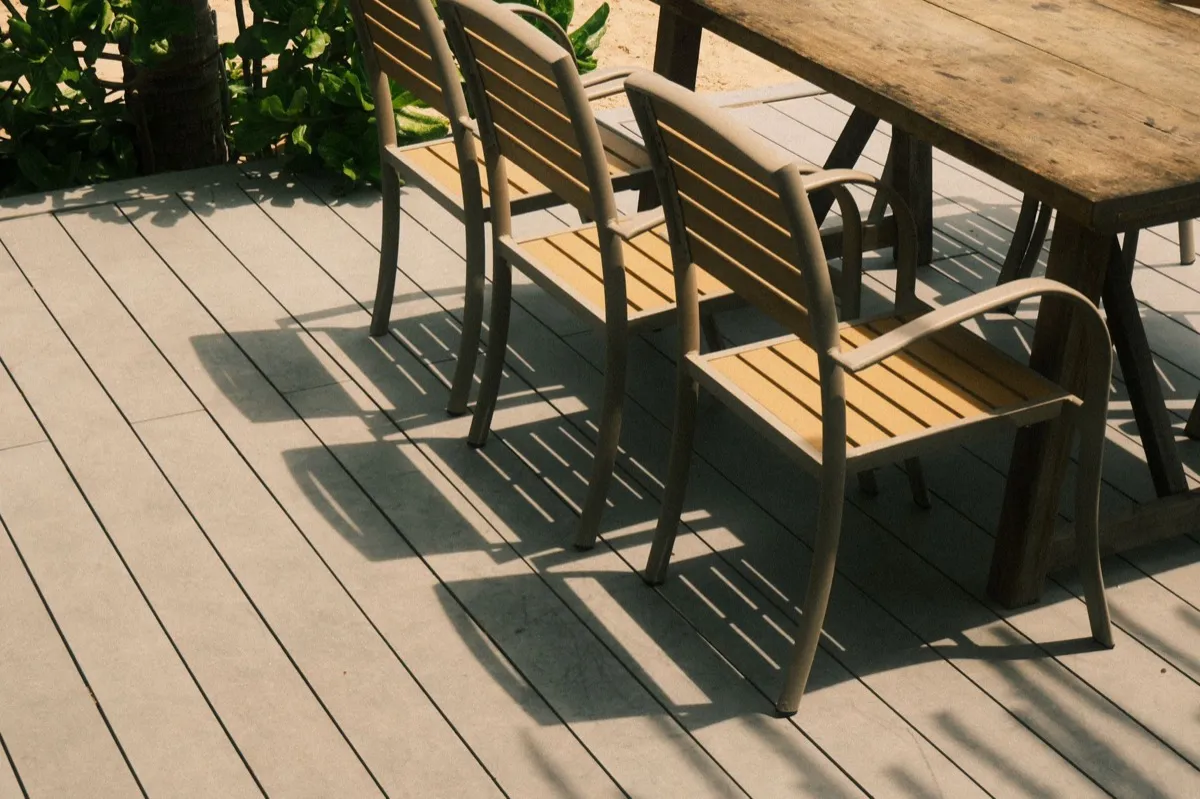
Composite wins on maintenance and lifespan. Wood wins on price and on how it feels under a bare foot in July. That's the whole comparison in two sentences, and everything below is you figuring out which of those two things you care about more.
The version you'll read on manufacturer sites goes differently, because a composite brand comparing itself to wood is a fox reviewing henhouse security. So here's the McAllen version, including the part where wood is genuinely the right answer.
The short comparison
| Wood (pine, cedar) | Composite / PVC | |
|---|---|---|
| Installed cost/sq ft | $25–$48 | $35–$60 |
| Surface lifespan | 10–15 years | 25–50 years (warranty length) |
| Upkeep | Clean + stain every 2–3 yrs | Soap, water, a brush |
| Barefoot heat in full sun | Cooler | 10–35°F hotter, color-dependent |
| Can be refinished? | Yes, sand and re-stain | No, scratches are permanent |
| Splinters / cracking | Yes, with age | No |
Takeaway: composite costs 30 to 50 percent more on day one and roughly nothing after. Wood costs less on day one and asks for a weekend every couple of years, forever.
The cost question, honestly
Composite deck boards run $5 to $14 per square foot for the material; pressure-treated pine is $3 to $6. Installed, the gap narrows in percentage terms because labor is 50 to 70 percent of any deck bid and framing a deck takes the same hours either way. Our full per-square-foot cost breakdown has the size-by-size numbers.
Now the ten-year number, which is the one that actually decides this. A wood deck needs cleaning and re-staining every 2 to 3 years. Call it $250 to $600 in materials each round, or hire it out for $2 to $5 per square foot. Over ten years that's $1,000 to $2,400 and four weekends you spent on your knees with a pad applicator. Composite over the same decade: a bucket of soapy water twice a year.
That's not a knockout for composite. It's a trade, and plenty of people would rather pay $2,000 later than $4,000 now.
Where composite actually loses: heat
This is the one nobody selling composite volunteers, and in the Rio Grande Valley it matters more than anywhere.
Composite boards run 10 to 35 degrees hotter than untreated wood in direct sun. On a bad afternoon that is the difference between a surface you stand on and a surface you cross in two hops, and it is why plenty of dark composite decks go unused between noon and 5 p.m. Color, not brand, drives most of the spread — measured board-by-board figures are in the hot-climate decking guide, and they are more convincing than any argument we could make here.
The fix is free: choose a light board. Manufacturers also now sell heat-mitigating lines that claim up to 35 degrees cooler than their own standard boards, and PVC generally reads cooler than wood-filled composite. If you want the deep espresso color, put it somewhere shaded, or plan on a pergola or shade structure over it.
Wood is not exactly cool either. Nothing is, at 3 p.m. in August. But wood dissipates heat faster and doesn't hold it the way a plastic-capped board does.
The technical part your bid should mention
Composite is not a drop-in swap for wood boards, and this is where DIY jobs and cheap installs go sideways.
- Joist spacing. Most composite requires joists at 16 inches on center for boards run perpendicular, and 12 inches on center for a 45-degree diagonal pattern. Plenty of older frames are built at 24 inches. Put composite on 24-inch spacing and you get a bouncy, wavy deck and a voided warranty.
- Stair stringers. Many composite makers cap stringer spacing at 12 inches on center, tighter than wood needs, because the tread flexes more.
- Thermal movement. Composite expands and contracts with temperature more than wood does. End-to-end and butt gaps come off the manufacturer's chart based on install temperature — get it wrong on a 100-degree day and the boards buckle in January, or gap like a picket fence.
- Hidden fasteners. Composite is where clip systems earn their money: a grooved board with hidden fasteners gives you a surface with no screw heads to collect grit, and consistent spacing enforced by the clip. Add about $0.60 to $1.30 per square foot.
- The frame is still wood. No composite on the market is structural. Your joists, beams and posts are pressure-treated lumber or steel regardless, which is why ground-contact-rated framing and flashing matter just as much on a composite deck.
Where wood actually wins
Beyond price and heat, wood has two honest advantages.
It can be repaired invisibly. Scratch a composite board and you own that scratch. Gouge a cedar board and you sand it, stain it, and it disappears. On a deck that will host dogs, patio furniture on casters, and someone dragging a smoker around, that's worth real money.
It looks like wood, because it is. Capped composite has gotten genuinely good, but the pattern repeats every few boards and you will notice. Cedar has grain that doesn't repeat, and it takes a semi-transparent stain in a way no plastic will.
The opinion: pick by how long you're staying
Buy composite if you'll own the house 8 or more years. Buy wood if you won't.
That's the whole rule, and the number behind it is the maintenance math above: it takes roughly three stain cycles — 8 years or so — for wood's upkeep cost plus your weekends to catch up to composite's price premium. Sell at year 3 and you paid a 30 to 50 percent premium so the next owner could enjoy easy Saturdays.
Anyone who tells you composite is always the right answer is selling composite. Anyone who tells you wood is always cheaper hasn't priced stain lately.
When to do neither
Straight talk: if your frame is solid and only the top boards are ugly, don't build a new deck at all. Resurfacing — new decking and railing on the existing substructure — runs roughly $12 to $22 per square foot versus $25 to $60 for new construction. Same look, half the money, and no demolition. The one thing to check first is joist spacing, because a 24-inch-on-center frame rules out most composite.
And if the deck is just gray and tired rather than failing, a proper clean and stain or seal costs a few hundred dollars and buys you two or three more years to decide. We'd rather tell you that than sell you a teardown.
Explicamos las dos opciones y el presupuesto en español si le resulta más fácil.
Get both numbers side by side
The right way to settle this is to hold two real bids for your actual deck: one in wood, one in composite, same footprint, same railing, same frame spec. The gap is usually smaller than people expect, and once you see it in dollars the decision makes itself in about a minute.
McAllen Elite Deck Builders builds both and will quote both without steering you. Call (888) 321-3875 and ask for the side-by-side.
Ready for a free quote in McAllen?
McAllen Elite Deck Builders — free estimate, clear scope, no pressure. Use the form on this page or jump to the homepage quote.
Related services in McAllen
McAllen Elite Deck Builders money pages — go straight to the service you need.
- Composite Decking (Trex & TimberTech) →
Composite decking is the default choice for most McAllen backyards, because it will not splinter, will not need a stain every second spring, and does not feed the subterranean termites that never go dormant in Hidalgo County. We install capped composite in the Trex and TimberTech lines over a full ground-contact pressure-treated substructure, using hidden clip fasteners in grooved boards so the finished surface has no screw holes collecting water and grit.
- Cedar Decks →
Cedar decks stay cooler underfoot than any synthetic board, which is why western red cedar is still the right answer for a McAllen deck that gets full afternoon sun and no roof over it. We build in clear and select-grade cedar with tight vertical grain, fastened with stainless steel screws, on a ground-contact pressure-treated substructure that never depends on the cedar for its structural life.
- Deck Staining & Sealing →
Deck staining in the Rio Grande Valley is governed by ultraviolet light, and our sun load shortens every recoat interval printed on the can. We strip, brighten, sand and refinish wood decks in McAllen using penetrating oil-based semi-transparent stains with ultraviolet inhibitors, applied at the right moisture content and out of direct midday sun, on a realistic 18-to-30-month cycle.
- PVC & Cellular Decking →
Cellular PVC decking contains no wood flour whatsoever, which makes it the most rot-proof and termite-proof surface you can walk on in the Rio Grande Valley. We install PVC board in the Azek and TimberTech lines on pool surrounds, spa decks, second-story decks over living space, and any job where a client wants the lowest-maintenance product available rather than the least expensive one.
- Redwood Decks →
Redwood decking is the premium natural-wood surface we build in McAllen, and clear all-heart redwood is harder, denser and more dimensionally stable than western red cedar while staying just as cool underfoot. We use it where the wood itself is the point: exposed decks, wrapped posts, built-in benches and visible fascia, always fastened with stainless steel over a pressure-treated substructure.
Frequently asked questions
Is composite decking better than wood?
Better at staying alive, worse at staying cool. Composite carries a 25 to 50 year warranty and needs soap and water; wood needs a stain every 2 to 3 years and lasts 10 to 15 years on the surface. But dark composite gets hotter barefoot than wood does. Pick on maintenance tolerance, not on marketing.
What are the disadvantages of composite decking?
Four real ones: it costs 30 to 50 percent more up front, dark colors get noticeably hotter in direct sun than wood, it can't be sanded or refinished if it scratches, and it expands and contracts more with temperature so end gaps have to be spaced by the manufacturer's chart. Nothing about it is structural either — the frame under it is still wood or steel.
Does composite decking get hotter than wood?
Yes, usually by 10 to 35 degrees in direct sun, and color drives most of that gap. Builder testing with a thermometer puts light and dark boards from the same product family more than 10 degrees apart. Choosing a light board instead of a dark one is worth more to your bare feet in McAllen than any brand you pick.
Is a composite deck worth the money?
If you're staying in the house 8 years or more, yes. A wood deck asks for roughly $250 to $600 of stain and a weekend every 2 to 3 years, which is $1,000 to $2,400 and four weekends over a decade. If you're selling in 3 years, cedar or pressure-treated pine is the better financial call and nobody should talk you out of it.
Can you put composite boards on an old wood frame?
Sometimes, and it's the cheapest way into composite. The catch is joist spacing: most composite needs joists at 16 inches on center for perpendicular boards and 12 inches for a 45-degree pattern, and older frames are often built at 24 inches. If the frame is sound and spaced right, resurfacing runs about $12 to $22 per square foot. Call (888) 321-3875 and we'll check the spacing before you buy boards.
Local context
How this applies in McAllen, TX
Every article here is written from deck building work done in McAllen and the Rio Grande Valley, so the numbers reflect local labour, permit and material costs rather than a national average. Your own job can land either side of them depending on access, the condition of what is already there, and the materials you pick — capped composite and cellular PVC decking, ground-contact pressure-treated southern yellow pine framing, western red cedar and clear all-heart redwood.
The way to turn any of this into a real answer is to have someone look at your actual situation. The free estimate is free, itemized and written down, with no deposit and no obligation. Call (888) 321-3875 or start on the McAllen Elite Deck Builders homepage.
Areas McAllen Elite Deck Builders covers
McAllen first, then the surrounding communities of the Rio Grande Valley. Each has its own page with local detail rather than a copy of this one:
- Edinburg, TX — Hidalgo County seat, incorporated in 1919, population about 100,200, and still the fastest-growing city in the county
- Mission, TX — Hidalgo County, incorporated in 1910, population about 85,800, spread over roughly 36 square miles of former citrus groves
- Pharr, TX — Hidalgo County, incorporated in 1916, population about 79,700, across roughly 24 square miles running down to the river
- San Juan, TX — Hidalgo County, incorporated in 1917, population about 35,300, over roughly 11 square miles of former irrigated farmland
- Alamo, TX — Hidalgo County, incorporated in 1924, population about 19,500, across roughly 7.5 square miles between the expressway and the river
- Donna, TX — Hidalgo County, incorporated in 1911, population about 16,800, over roughly 8 square miles of Delta-area farmland
Or jump to the full list of McAllen services.
More from the McAllen Elite Deck Builders blog
- Deck Cost Per Square Foot in McAllen: Real Numbers
Most decks run $25 to $55 per square foot installed. The honest math for McAllen, TX by material and by size, plus 3 things that inflate a bid.
- Ipe vs Trex: Which Survives McAllen Sun Longer?
Ipe lasts 40+ years at $55-$80 a square foot installed. Composite is half that and needs no oil.
- Deck Railing Height Code: 36 or 42 (McAllen)
Residential decks need 36 inches minimum, commercial 42. Guards start at 30 inches up.
The McAllen Elite Deck Builders Team
deck building specialists serving McAllen, TX
Written by the McAllen Elite Deck Builders team — insured deck building pros with 20+ years serving McAllen, TX and the surrounding area.